Anthropic’s J-Space Discovery: Anthropic J-Space Claude AI Tool Development Implications 2026
Affiliate Disclosure: Founder’s Wire is reader-supported. Some links in this article, including links to Claude, Hostinger, and other tools, are affiliate links. If you sign up through them, we may
Affiliate Disclosure: Founder’s Wire is reader-supported. Some links in this article, including links to Claude, Hostinger, and other tools, are affiliate links. If you sign up through them, we may earn a commission at no extra cost to you. We only recommend tools we’ve used or rigorously researched. Our opinions are our own.
Most technical founders audit an AI product by watching the output- what it prints. When the reasoning is traced, it looks like the model’s logic laid bare, right before you. And if that trace holds up under scrutiny, you might assume the process behind it holds up too.
Here’s some interesting news. Anthropic published a research paper on July 6, 2026 that changes that assumption a little bit. This is the Anthropic J-space Claude AI tool development implications 2026 story every founder building on Claude needs to sit with. It turns out Claude does a chunk of reasoning work that is never visible text but somewhere inside the model.
If you’re building on the Claude API, this is worth sitting with. Claude isn’t hiding anything on purpose. It’s more that the reasoning you thought you’d been auditing this whole time might not have been the full story. Here’s what Anthropic found and what it changes for your prompts, your reliability assumptions, and what you can confidently tell a buyer who asks how your AI works under the hood.
Anthropic’s J-space Claude AI Tool Development Implications 2026: The Research, Explained
The tool behind this is called the Jacobian lens, or J-lens. For every word in Claude’s vocabulary, it measures the internal activation building up before Claude produces that word. Whether or not the word ever makes it into the final output.
If you run that across Claude’s layers, we have something that’s worth noticing. A small, high-priority cluster of activity Anthropic is calling J-space a place where the model appears to hold and work through concepts before generating anything at all.
This is not chain-of-thought. Chain-of-thought is text you can read when you ask Claude to reason through something out loud. J-space doesn’t work that way. It never shows up in your API response, your logs, or anywhere near your prompt output. And even though it only accounts for 6 to 10 percent of total activation variance per layer, it seems to carry a disproportionate share of what the model is actually doing.
If you pictured a group of specialists working alone in separate rooms. None of them can see what the others are doing, except for a single shared whiteboard everyone can read. That’s about what J-space is. Not where the thinking happens per se, but where the scattered results of it get pooled so the rest of the model can act on them. Anthropic tested this by changing what was written on that whiteboard mid-task, and Claude’s final answer shifted to match. It’s not just a coincidence. That’s causation.
What This Means for Prompt Engineering
I used to trust chain-of-thought more or less at face value. I could ask Claude to walk through its reasoning, and what it gave back sounded rational, considered, and plausible enough. But once you know J-space exists, you can’t fully trust the rationale Claude offers for its own conclusions anymore. Chain of thought is a window into part of the process, not the whole behavioral and mechanical process.
For a founder, this is not a minor change, but it should change your paradigm to prompting and how you ought to be prompting Claude in the light of this new discovery.
Stop asking Claude to “explain your thinking” and instead give it fixed conditions to justify its answer against. Open-ended narration gives Claude room to construct something that sounds convincing without necessarily reflecting what actually happened internally. Constrained justification closes a lot of that room.
What This Means for Production Reliability
We’ll examine what this means for production reliability. Testing has always felt like proof, more or less. Run fifty or a hundred sample cases, check the outputs, and if most of them work just fine, we ship it. That’s how teams have reassured themselves a Claude-powered system was ready for production.
With this research a new problem has surfaced. If your tool passes fifty test cases, it doesn’t prove the reasoning behind them was sound. It proves the outputs looked right for the fifty cases you happened to run.
Take a customer refund tool as an example. You tested it against a hundred sample complaints. Ninety-eight came back correct, two were borderline but close enough, but you shipped it. A few weeks in, a real world complaint arrived that your test set didn’t include or was part of. It needed two or three additional pieces of context the tool didn’t have the build to take on. Now, there’s no way to see what happened inside J-space for that specific case. Which means there’s no way to know the model handled it differently until it’s already live and something’s already broken.
You must be asking yourself, how do I fix this? Not more output-checking. A benchmark the output has to clear before it ever reaches a user, one built from independent rules that don’t care how convincing Claude’s explanation sounds. For a refund tool, that might just mean any approval over $50 gets automatically flagged for human review. No exceptions. That rule doesn’t need to trust Claude’s reasoning at all. It just checks what actually happened.
What This Means for Enterprise Security Audits
Picture the moment with me. A compliance team asks you, “Does watching Claude’s chain-of-thought actually show you how the whole system reached its decision, or just part of it?”
Before this research, you might’ve said yes without thinking twice. The answer now is that it’s a bit different. Claude’s chain-of-thought is the piece we can see, and because we see it, we point to it. But the layer to which Claude reasons stays hidden inside what Anthropic calls J-space, and it isn’t going to show up in anything you can hand an auditor. You didn’t do anything wrong. It was a property of the model itself nobody could fully account for until this research made it visible, even to Anthropic.
Does this change what you can claim in a security review? Absolutely yes! You can still point to your chain-of-thought validation. That’s valid, and it still counts for something. But you can’t claim it covers the entire decision-making process anymore. What you can stand behind instead are the independent checks built into your system The rules and human checkpoints that catch bad outcomes regardless of what happened inside Claude to produce them.
Where J-Space Sits in Claude’s Architecture
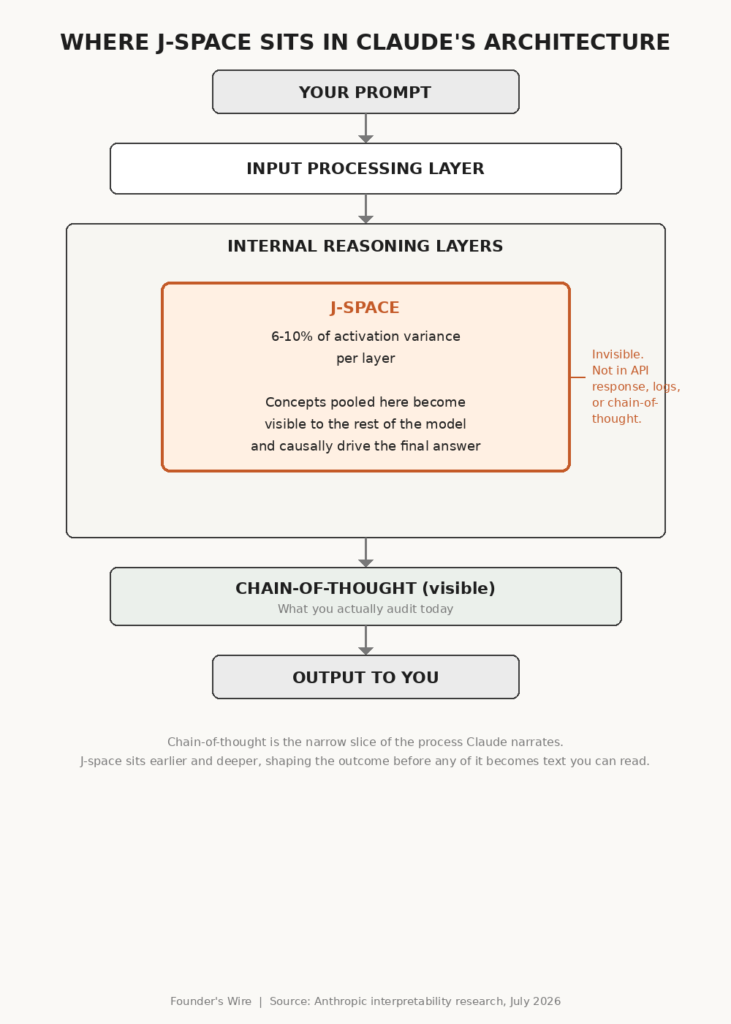
Chain-of-thought is the narrow slice of the process Claude chooses to narrate. J-space sits earlier and deeper, shaping the outcome well before any of it turns into text you read.
What to Actually Change in Your System
If you’re building on Claude right now, here’s what’s genuinely worth changing.
Start with your prompts. First, stop asking Claude to explain its thinking; hand it fixed conditions and make it justify its answer against them. You’re constraining it against rules you set, rather than leaving it free to generate whatever sounds most convincing in the moment. It’s astounding the difference this small change can make.
Next, stop treating a passing test suite as proof you’re ready to ship. A model tool that clears your test cases still needs to be checked against something sturdier. A benchmark layer weighing results against defined rules rather than just how plausible the output sounds.
Then add a low-latency validation proxy for your highest-risk outcomes. It sits between the user and the tool, checking output against your rules in milliseconds before anything goes out the door. It’s not a person reviewing every single case. Just a lightweight system built to catch specific conditions, a refund over $50, say, and flag it before the user ever sees it go through.
Where to Actually Build This
Everything above—the validation layer, the constrained prompting, and the low-latency checks—gets implemented on Anthropic’s platform itself. That’s where the benchmark and validation logic gets wired in alongside your calls to the model. If you haven’t set up production access yet, Claude’s API platform is where to start.
Where you host it matters too. You’re running checks that need to respond fast, especially anything touching live customer interactions. Hostinger’s AI hosting is built for that kind of instant, low-latency deployment. Infrastructure that won’t slow down the validation proxy you just built, without the overhead of an enterprise cloud setup you probably don’t need yet as a small startup founder.
If you’re weighing whether Claude fits your team beyond just the API, our Claude for Business breakdown covers that separately. And if you’re comparing tools across your stack rather than committing to one, our Notion AI review is worth a look too.
Building on Claude in 2026: US, UK, Canada, and Nigeria
None of this plays out the same way everywhere. Your market shapes how much latency, cost, and infrastructure access actually matter for the validation layer walked through above.
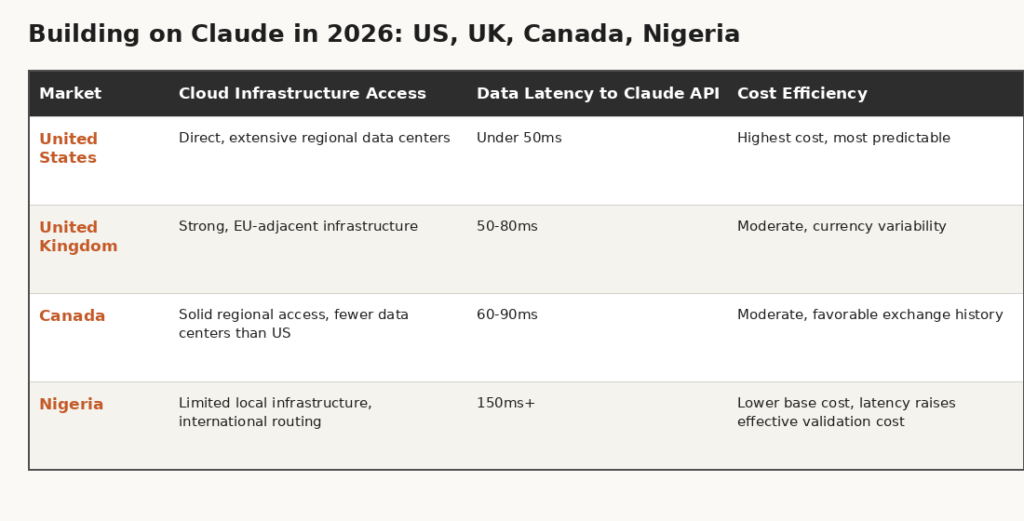
For a founder in Lagos running that low-latency validation proxy, an extra 100ms of routing distance isn’t a rounding error. It’s the difference between a check that’s genuinely invisible to the user and one that isn’t.
Worth It Verdict: Is This Worth Changing Your Build Over?
Yes, because J-space is not just one-off curiosity in my opinion. Research tends to build on itself. Anthropic didn’t stop interpreting Claude on July 6, they most likely opened a door, and whatever comes next is more likely to extend this finding than replace it. Ignoring it now means you’re missing out on the paper and starting the next one behind.
I don’t mean you should tear everything down tomorrow. It means the three changes above, by constraining prompting, setting benchmark-based validation, a low-latency proxy for high-risk outcomes, are worth doing this month, not just eventually. My verdict is to make small, contained changes, which don’t really require rebuilding your architecture from scratch all over again.
Stay close to what Anthropic actually publishes helps you to end up with more reliable products.