Snap Just Launched $2,195 AR Glasses—Is This the Future of Work for Founders?
Snap just priced its first consumer AR glasses at $2,195, roughly fifteen times the price of its first spectacles released in 2016 at $130. That number tells you where Snap
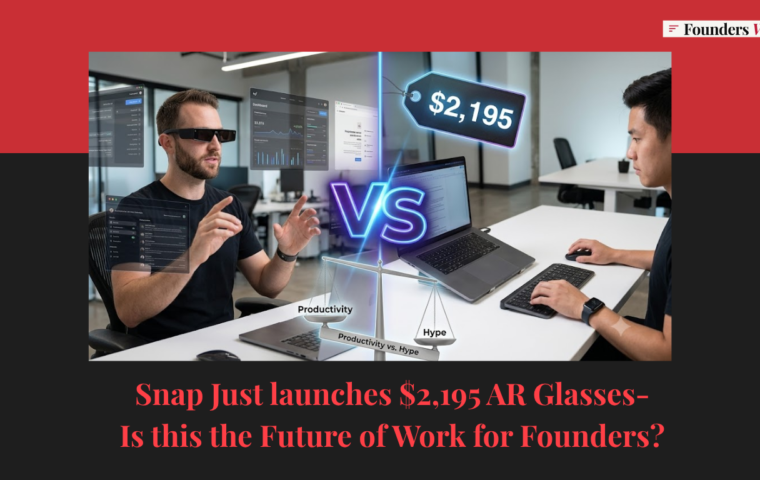
A Founders Wire visual brief — commissioned for this report.
Snap just priced its first consumer AR glasses at $2,195, roughly fifteen times the price of its first spectacles released in 2016 at $130. That number tells you where Snap thinks the real value sits. A price like this isn’t a casual purchase; it’s a business hardware price.
We are not here to discuss Specs’ appearance or feel. What we’re talking about is whether Snap Spectacles AR glasses for business make sense as a line item for a budget-conscious founder. After reviewing what Snap has announced, I believe the honest answer is somewhere between yes and not quite.
What Are Snap Specs?
This is the sixth generation of AR hardware, unveiled at Augmented World Expo in June 2026, and the first version built for buyers outside the developer community.
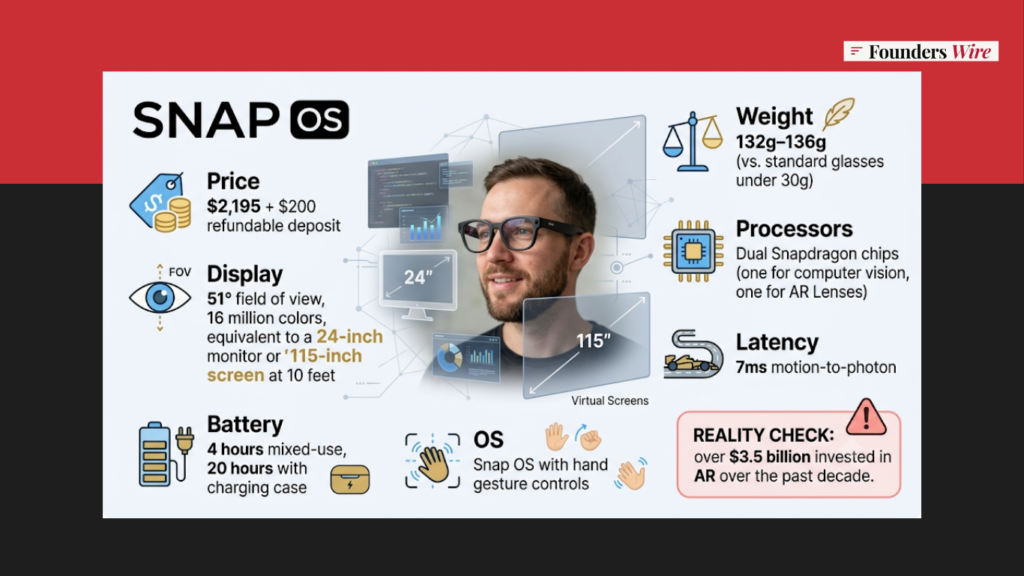
It runs on a 2-Snapdragon chip that allows augmented reality. One of the chips handles activities like understanding your hands and the space around you, while the other runs the actual AR programs (Lenses).
The display system is a proprietary liquid-crystal-on-silicon panel with a 51-degree diagonal field of view. In reality, it gives the feel of an 115-inch screen placed 10 feet away from you. If you are a lover of shades, it gets better. Specs has electrochromic lenses, which tint in just 10 seconds when you step outside.
But its battery life is short. It has about 4 hours of regular use which can stretch to about 20 hours with a charging case. The frames are made from Swiss TR90 polymer and come in two sizes, one weighing 132g and the other 136g. There is an additional option to add prescription lenses.
Specs is positioned as a bridge between light AI glasses and something as bulky as Apple’s Vision Pro.
What Snap Specs AR Glasses Actually Get You
Snap has been quietly building out developer infrastructure for close to two years. It included ten operating system updates, more than forty new features, and hundreds of Lenses already published before Specs even reached the public.
Lens Studio, the free desktop tool used to build for the platform, now includes a native development Kit that lets developers bring in existing code written in C or C++ instead of starting from scratch; a tool that migrates projects out of Unity automatically; and a commerce layer for handling payments and subscriptions inside a Lens from day one.
Snap also opened up support for building through AI coding assistants like Claude Code, Cursor, Codex, instead of forcing developers to learn an AR-specific workflow from scratch. Snap confirmed that Mapbox ported its navigation engine into Lens Studio in under two hours using the new tools, and Niantic is doing something similar with its positioning system.
None of that is theoretical. It’s shipped, and it’s a lower technical bar than AR development has had before.
What’s missing is the layer that would make this a business tool rather than a platform for builders. I went looking for anything resembling a meeting app, a calendar Lens, a way to run a client call through these glasses and came up empty. Snap’s own framing leans hard into “computing that sees what you see,” which is a genuine platform ambition. But it’s not the same as a shipped product a non-technical founder can hand to her team on day one.
Where the Value Lies For Founders
Client presentation: carrying a laptop, a system, or even a projector during presentations can look like a lot of stress, but with Specs, it’s not. The augmented reality glasses can project a large virtual screen that looks as big as a television to you. You can present slides, designs, or prototypes without the need to squint at a laptop screen.
Remote collaboration: In articles published by Snap or early reviewers, there are no video call or shared workspace lenses built for these glasses.
The $2,195 Question
If you are a bootstrapping founder, $2,195 is valuable money that can go into several months of software subscriptions or even salaries for your new employees. So buying this product has to be justified.
So what does that money actually buy today, beyond a laptop, a decent webcam, and the tools already in your subscription list? Not much, if what you’re hoping for is a general productivity upgrade. The presentation use case is real but narrow. The remote-collaboration and hands-free-ops use cases that would make this an obvious yes for most founders aren’t built yet. Where the price starts to make sense is if you’re not just buying a tool to use but buying early access to a platform you intend to build on—a developer stack that’s genuinely more advanced than what similar hardware has offered before.
Where Snap Specs AR Glasses for Founders are Available
Currently, Specs is only available for preordering in the United States, United Kingdom,, and France. Individuals in other regions may have to wait for either a global rollout or import from the US market.
In the United States, Specs is available for preorder at the rate of $2,195, with a refundable deposit of $200.
For consumers in the United Kingdom, Specs is available for preorder at £1,995. It isn’t a direct currency conversion of the US price, which shows that the UK founders are paying a premium likely reflecting VAT and import costs, not just FX.
In Canada, the rate is about CAD 2900 – 3000 at the current exchange rate. But this is only estimated, as the product isn’t available in Canada.
It is also not available in Nigeria.
Is It Worth It? Our Verdict
Over the years, several manufacturers have claimed that augmented reality was about to become mainstream. That hasn’t happened, so it’s reasonable to be skeptical of another.
But Specs may be different as it is Snap’s sixth hardware generation after about 10 years of development. Roughly $3 billion has been invested in its research and development. It has a strong set of tools, documentation, and resources for developers to start building immediately.
What needs work is the adoption math: a four-hour battery, a $2,195 price tag, and availability in exactly three countries. These limitations make it difficult for the product to be widely used by everyday businesses.
Spec is worth it for founders who will benefit from building on the platform before competitors, early adopters who enjoy trying new technology, and developers who want to create software for the platform. But if you don’t have such a compelling need, it’s probably smarter to wait 12 to 18 months. By then the price may be lower and more features available.
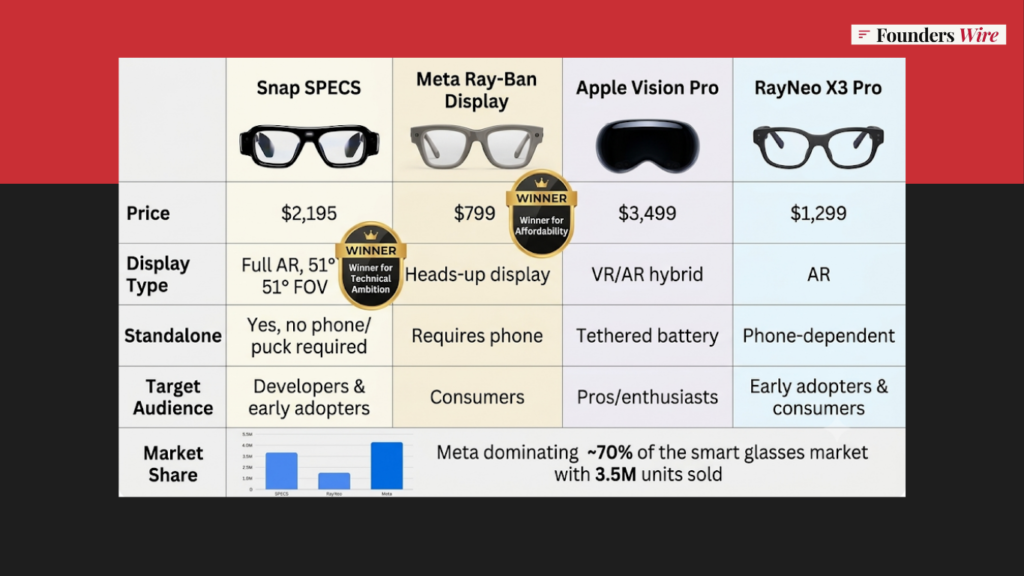
In the meantime, you have two lower-risk options. The first is free: download Lens Studio and build in the simulator, which gives you a real feel of the platform without the hardware spend. The second is Meta’s Ray-Ban Display, at $799 which is a much smaller feature set, at a lower price when compared to Specs.
Thank you for reading! Perplexity Computer helps you operate like you have a full product team, Is this true and is it worth it for a solo founder? Read more to find out. Click here

